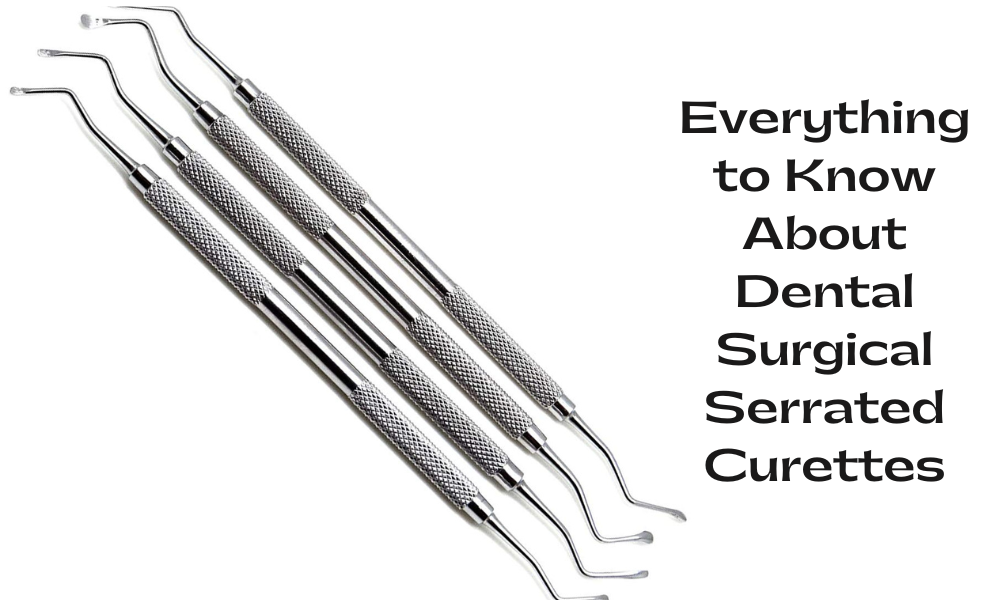
Every dental professional must be thoroughly familiar with the essential dentistry equipment required to provide optimal oral healthcare for patients.
Instruments such as serrated surgical curette are vital for all oral healthcare treatments. In dental surgery, these tools are used to meticulously scrape away plaque, tartar, and cavities from teeth and surrounding tissues.
Often, dental issues like calculus deposits can accumulate on tooth surfaces, causing discoloration and deteriorating oral hygiene. This is precisely where handheld instruments like curettes are indispensable for oral hygienists. Surgical serrated curettes further assist dental professionals in procedures such as tooth scaling, implant placement, and root planing. For a closer look at this, see FBA Training Courses.
Overall, without curettes, no dental hygienist can confidently ensure a patient’s mouth is thoroughly cleaned and maintain a healthy, bright smile.
Significance of Dental Surgical Curettes in Dentistry
As previously discussed, conditions such as gingivitis or other periodontal diseases diagnosed by dentists are effectively treated using curettes. Such dental problems typically arise due to poor oral hygiene and the accumulation of tartar. Surgical curettes are essential hand instruments designed to reduce oral microbial load responsible for inflammation and gum disease. Untreated gingivitis can cause severe gum bleeding and swelling, while failure to remove plaque and tartar buildup can lead to advanced periodontal disease known as periodontitis.
Dental Curette Functions
Dental curettes offer multiple uses due to their innovative design enhancements, enabling dental surgeons to perform treatments like root planing efficiently and safely.
- They minimize patient waiting time and lower the risk of oral tissue damage.
- Curettes effectively remove plaque and tartar while addressing various tooth-related issues.
- Besides eliminating diseased tooth roots and periodontal fibers, they facilitate precise incisions in sensitive tissues.
- They help remove the soft tissue lining of periodontal pockets, which is critical for gum health maintenance.
These handheld dentistry instruments come with either sharp or dull blade tips, allowing dentists to select the appropriate tool based on the specific dental procedure. When used correctly, surgical dental curettes are invaluable both in diagnosing oral health issues and in performing surgical interventions.
Types of Surgical Serrated Curette
Understanding the construction, layout, and sizes of dental curettes is crucial to selecting the right instrument tailored for specific dental surgeries.
Here are the main types of surgical curettes:
Universal Curette
Universal curettes feature symmetrical counterparts, including shanks and blades, ensuring that dental surgeons comfortably grip and manipulate the instrument during treatment of dental calculus. When tooth surface plaque becomes difficult to remove due to consistent calculus buildup, the universal curette’s 90-degree angled shank allows access to hard-to-reach areas, enabling effective scaling and cleaning.
Gracey Curette
Gracey curettes are area-specific dental tools characterized by blades offset at approximately a 70-degree angle. This design provides a clear view and precise access to targeted mouth areas, ensuring a flawless surgical procedure. Various Gracey curette sizes and designs are available, including long shanks and pointed working ends tailored for specific clinical needs. These curettes are curved both laterally and from toe to shank, which dental surgeons must maintain carefully during cleaning and sharpening.
Things to Consider When Buying Dental Surgical Curettes
Handle Grip and Shape
Curettes included in the dental instrument kit must have ergonomic handles offering a secure and comfortable grip. This reduces hand fatigue and strain on the arms, enabling dental practitioners to perform precise procedures without discomfort. Different handle shapes serve specific functions, enhancing the tool’s appropriateness for various dental applications.
Adjustable Handle Designs
Surgical curettes come with handles ranging from flat to serrated designs. The handle’s shape significantly affects the dentist’s ability to diagnose oral health problems accurately and execute treatments effectively, emphasizing the importance of selecting the right handle design based on clinical needs.
Made From High-Quality Materials
The quality of dental curettes directly impacts their performance. Instruments manufactured from premium-grade, durable materials such as German stainless steel offer superior strength, corrosion resistance, and longevity, ensuring consistent and reliable clinical outcomes.
Conclusion
In conclusion, understanding the different types, purposes, and functionalities of dental surgical curettes is indispensable for any dental practitioner. Being knowledgeable in selecting the ideal curette enhances treatment effectiveness, accommodates multiple surgical needs, and elevates the reputation of dental practices. Investing in high-quality curettes tailored to clinical requirements ultimately leads to improved patient satisfaction and oral health outcomes.
Thanks for reading!
Additional Insight: The role of dental surgical curettes extends beyond simple plaque removal. Modern curettes are designed using ergonomics and advanced materials to reduce practitioner fatigue and increase precision during delicate procedures. Innovations such as ultrasonic curettes are now being integrated into dental practices, combining manual techniques with ultrasonic vibrations for enhanced removal of calculus and biofilm. Staying updated on the latest advancements in curette technology is essential for dental professionals aiming to provide minimally invasive, effective, and patient-friendly oral healthcare solutions.